

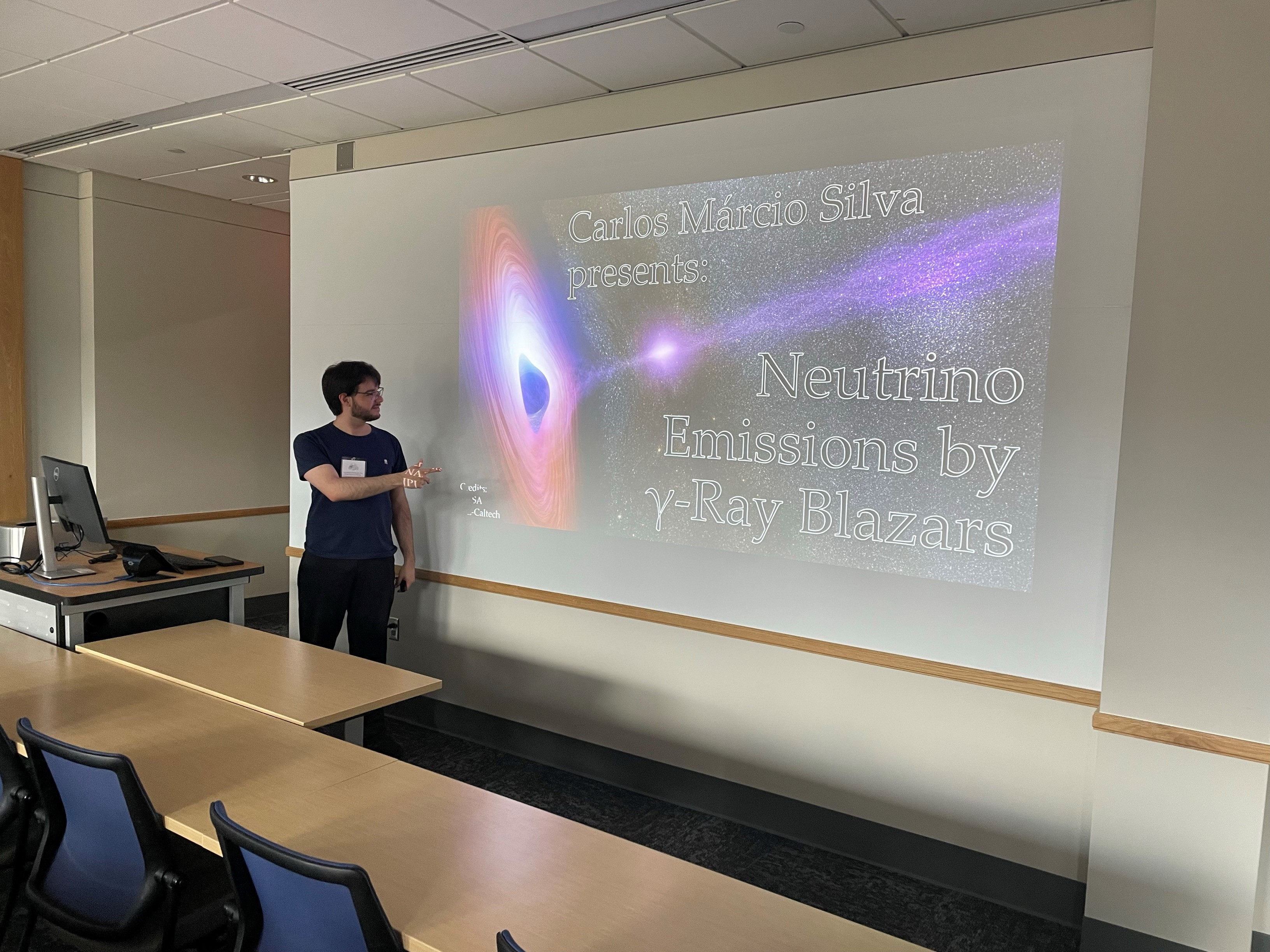
A senior John H. Martinson Honors Program (JMHP) student, Carlos Márcio de Oliveira e Silva Filho was recently announced as Georgia Tech's 2026 A. Joyce Nickelson and John C. Sutherland Undergraduate Award winner. This incredible honor is annually presented “to a top student in the college whose academic work spans mathematics and physics.” Carlos was nominated by both the School of Math and School of Physics for his excellent research and exceptional contributions in both of the aforementioned fields. He’s instilled major headways in discovering and studying “the intersection” of math and physics and “how they connect.” This is his passion.
Research at Georgia Tech
Carlos's research at GT is primarily within the IceCube Collaboration, where he and his team study Arctic ice samples using “light sensors scattered about one cubic kilometer of ice,” an effort to find neutrino interactions through the light study in the observatory by identifying a soft glow produced by the interactions. Neutrinos are three of the 17 “fundamental particles that are indivisible” – they are incredibly minuscule, even smaller than atoms, and as a result, they rarely “interact with anything.” For context, Carlos explained that “throughout your whole lifetime we expect only one neutrino to interact with your body…to actually search for this [interaction], it’s really hard.” Studying these interactions from the clearest material available, arctic ice, allows for some interesting analysis and discoveries.
This research has brought Carlos into three ongoing papers on the following topics: neutrinos in blazar black holes, “a new kind of statistical model to try to constrain the properties of our analysis,” and finally, on “implementing AI” in order to further the project analysis and conclusions. Carlos has enjoyed his lab work at the IceCube Collaboration over the last three and a half years, and his biggest takeaway from his experience is ensuring strong relationships with his teammates. He recommends that students and researchers “find a group that you fit well in, [a group where you are] not only doing something that you like, but also [making sure] you enjoy the work department there.” Carlos reflects, “...I work really well with my PI. I’m really happy with my research group. We’re very supportive of each other…and I think that makes all the difference.”
Georgia Tech Academic and Extracurricular Career
As a double-major student in math and physics, Carlos’ course load has consistently been both challenging and exciting. Starting out as a physics major, Carlos mentions that he “started taking [physics] classes regularly,” but ultimately "realized that [he] did not know the math [he] needed for the physics [he] wanted to do.” The skills he needed for his goals would only be developed if he took additional math classes that substantiated his physics knowledge.
Upon taking linear algebra with abstract vector spaces, and then quantum mechanics, Carlos expressed that he “was really able to see physics…through the lengths of linear algebra and those connections.” This motivated him to double-major in math, expand his knowledge base even more, and dive into the research interests he had become intrinsically passionate about. Carlos additionally emphasizes that being intentional with course selection based on one’s specific future goals has been beneficial to his success at Georgia Tech.
As a JMHP student, Carlos started out his academic career at the Hefner-Armstrong dorms (before the program was relocated to Eighth Street). He fondly recollects his many study experiences in the Honors classroom, where one “could study and…socialize with other people…[where] it was…like an internal hub where we could make those connections” with other Honors students. Additionally, his favorite “non-physics, non-major class” was an HP English course focused on the genre of horror films. Taught by Dr. Eric Lewis, the class featured “watch parties” coupled with reflective evening discussions, with the added bonus of professor-supplied sweet treats to enjoy. The HP course allowed students a lot of freedom and personalized academic engagement in project selection, project execution, etc. - a highly commended element of the course.
Outside of his research endeavors, Carlos is involved with the Society of Physics Students community at Georgia Tech, the Brazilian Student Association, and recreationally plays Dungeons and Dragons, a hobby he’s been participating in “for well over a decade now.” He stresses the importance of having hobbies outside of work, expanding that “...I think [playing Dungeons and Dragons is] a nice bridge between having fun and friends and doing more of the creative side of things, like telling stories, playing characters” etc.
Reflections and Future Plans
As graduation nears, Carlos has planned to attend a Masters or PhD program in fundamental theoretical physics, and is currently in the application process for both program options. He describes this field as the study of “the core theory behind everything else,” essentially “the basis” of all other concepts. Within this next phase of his educational career, Carlos plans on shifting his research focus to a more "theoretical" and “math heavy” sector of physics, working with “creating theories, creating models,” etc., compared to his current, more “experimental,” work in particle astrophysics.
One day, he aspires to be both a professor at a university, in addition to a full-time researcher at The Institute of Advanced Study in Princeton, an institution filled with “[physicists]...historians…philosophers” all “doing theoretical work.” Not only is it a “very prestigious” institution to be a member of, but it also supplies all basic needs for researchers, such as housing and food so that researchers can fully focus on their craft and make incredible progress in their endeavors.
One concluding piece of advice from Carlos is that “you will only get as much out of the Honors Program as you put in….if you don’t go to the events, if you don’t take the classes, if you don't interact with your advisors, you won't get [good] things out of it.” A student’s experience at Georgia Tech is “really something [that should be] cooperative, and the Honors Program is here to make sure you’re having the most out of your experience.”
With that in mind, let’s give another warm round of applause to Carlos for his incredible academic and research accomplishments, and his acceptance of the A. Joyce Nickelson and John C. Sutherland Undergraduate Award. He will be honored at the GT Student Honors Celebration later this semester. All the best on your future successes, Carlos!
~Author: Sandhya Rajesh, John H. Martinson Honors Program student assistant